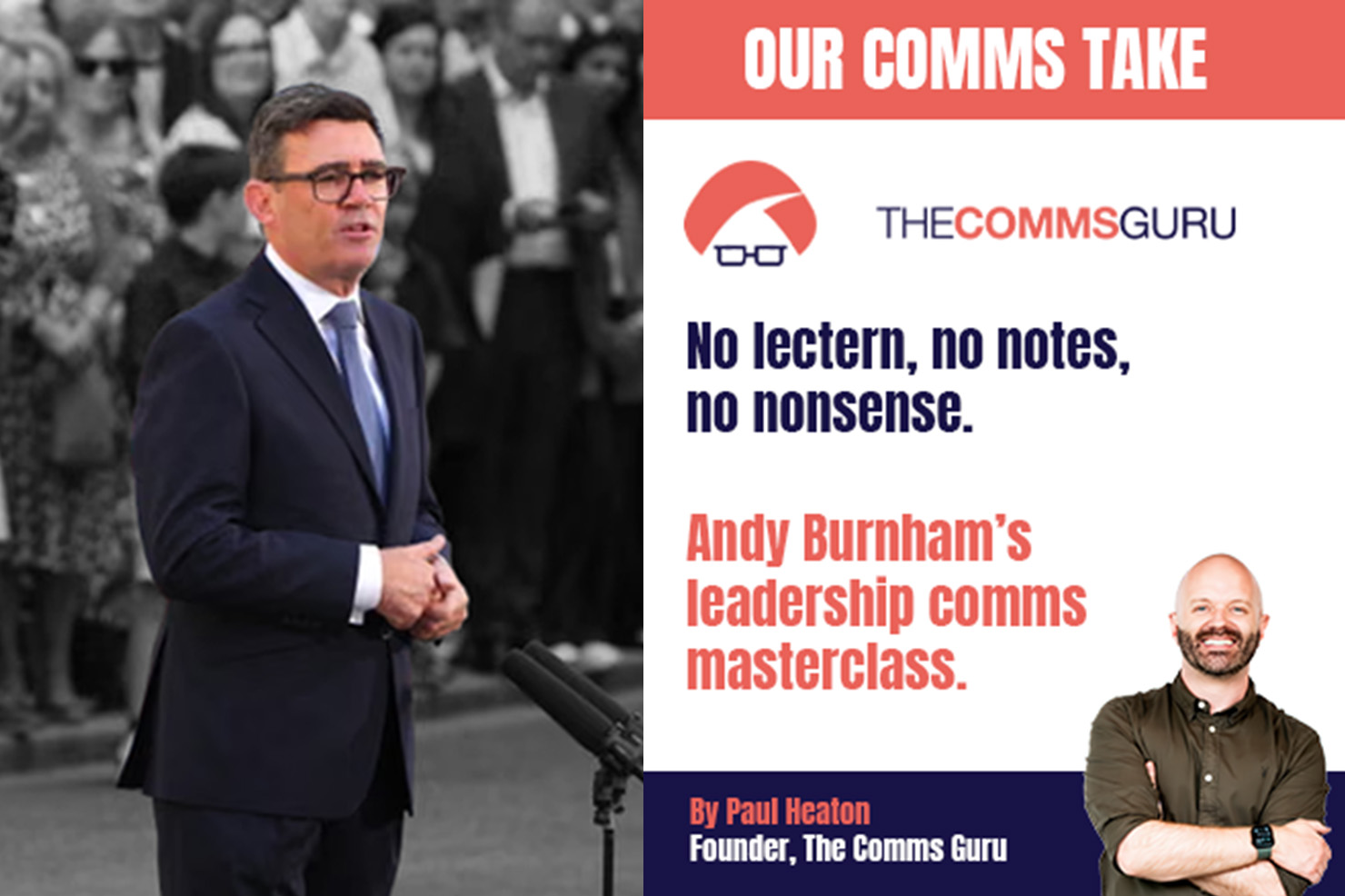
No lectern, no notes, no nonsense: Andy Burnham’s leadership comms masterclass

Andy Burnham’s first speech as Prime Minister felt different before he had even said a word.
There was no traditional Downing Street lectern separating him from the audience. No visible notes. No obvious teleprompter. Just Burnham, two microphones and the people standing in front of him. At several points, he looked directly down the camera lens and spoke to the people watching at home rather than simply addressing the journalists gathered in Downing Street.
It created a level of trust, directness and genuineness that I cannot remember seeing in British politics for a very long time.
The rejection of the traditional podium was widely noticed and immediately signalled a more informal and accessible style of leadership.
But this was not informality for the sake of it. Every element of the delivery supported the message he was trying to communicate: politics needs to change, leadership needs to feel closer to people, and power cannot continue to be exercised from behind the usual barriers.
For internal communicators, it was a masterclass in how the way a leader communicates can be just as important as the words they use.
Removing the barriers
Lecterns, stages, scripts and highly controlled settings can help leaders feel secure. But they can also create physical and emotional distance.
By removing the lectern, Burnham made himself more exposed. His whole body language was visible. There was nowhere to hide and nothing to hold on to. That vulnerability made the speech feel more human. The lack of notes or a visible teleprompter added to the impression that these were his words and his beliefs, not lines handed to him by a communications team five minutes earlier.
Of course, the speech will have been carefully prepared. Authentic leadership communication does not mean improvising everything. It means preparing so well that the message can be delivered naturally, confidently and in the leader’s own voice.
That is an important lesson for internal communications teams.
Our role should not be to turn leaders into corporate newsreaders. It should be to help them understand the message, believe in it and communicate it like a human being.
Speaking to people, not at them
Burnham frequently looked directly into the camera, creating the impression that he was having a conversation with each person watching from home.
That small choice matters.
Many leadership speeches are delivered to the people in the room while everyone else watches from the outside. Burnham made the television audience feel like the intended audience.
The same principle applies inside organisations. When a chief executive records a video, hosts a town hall or announces a transformation, are they genuinely speaking to employees? Or merely delivering a statement in their general direction?
Effective leadership communication anticipates what people are thinking:
- Why is this happening?
- What does it mean for me?
- What will genuinely change?
- Why should I believe this leader?
- What happens next?
A strong internal communications strategy helps leaders answer those questions consistently rather than treating communication as a one-off broadcast.
A simple, memorable idea
Burnham described his arrival as a “circuit breaker for Britain”, a memorable image that helped organise the wider speech. The country had become stuck in a cycle of political instability, centralisation and declining trust. His job, he argued, was to interrupt that pattern and create a different way forward.
This was more effective than presenting a long shopping list of disconnected priorities.
Incoming leaders often try to prove themselves by announcing five strategic pillars, ten commitments and a new set of values. Employees receive plenty of information but little sense of what it all means.
A good leadership narrative needs one central thought that people can understand, remember and repeat. It can then be reinforced through carefully planned internal communications campaigns, leadership activity and visible decisions.
How it differed from previous Prime Ministers
Recent incoming Prime Ministers have largely relied on the familiar Downing Street formula: stand behind a lectern, deliver a tightly scripted statement and introduce the government’s immediate priorities.
Keir Starmer spoke about service and the “calm and patient rebuilding” of the country. Rishi Sunak positioned himself as the leader who would correct previous mistakes and restore economic stability. Liz Truss introduced three immediate priorities for her government.
Burnham did more than announce a change of leader or policy direction. His delivery embodied his argument that leadership itself needed to change. He removed the physical barrier. He spoke in his own voice. He looked people in the eye. And he appeared prepared to trust himself with the message.
That made the speech feel less like the launch of another administration and more like a personal commitment.
What internal communicators can learn
Burnham’s speech offers four clear lessons for anyone supporting leaders through change:
Remove unnecessary barriers.
Think carefully about the stage, format and production. A polished setting is not always the most trusted setting.
Help leaders own the message.
Prepare them thoroughly, but do not script away their personality.
Speak directly to the real audience.
Address people’s experiences, questions and concerns, not simply the priorities leadership wants to announce.
Build everything around one clear idea.
A memorable narrative is more powerful than an overloaded presentation.
The real test, of course, is what comes next. Trust created through communication can be quickly lost if the decisions and behaviours that follow tell a different story. But as a first act of leadership communication, Burnham’s speech was confident, stripped back and remarkably human. It showed that sometimes the most powerful way for a leader to command the room is to remove the things traditionally placed between them and their audience.
How we can help
Helping leaders communicate like human beings is a big part of what we do.
- Leading people through change? Our change communications support helps leaders explain what is happening, why, and what it means for their people.
- Planning a leader video or town hall? We make leader videos that feel natural rather than scripted.
Need help creating a leadership narrative that feels genuine rather than corporate? Book a free discovery call with The Comms Guru and let’s have a brew and a chat.
Keep reading
.jpg)


Let’s work together

Kick-ass comms. No corporate nonsense.
Guru Mail
Internal comms, minus the blah. In your inbox.
Roughly monthly. A template you can use, a straight opinion and the best thing we have read.
Sign up nowWhat we do
Pick a solution
How we work
Resources




 Certified Members of the Institute of Internal Communication