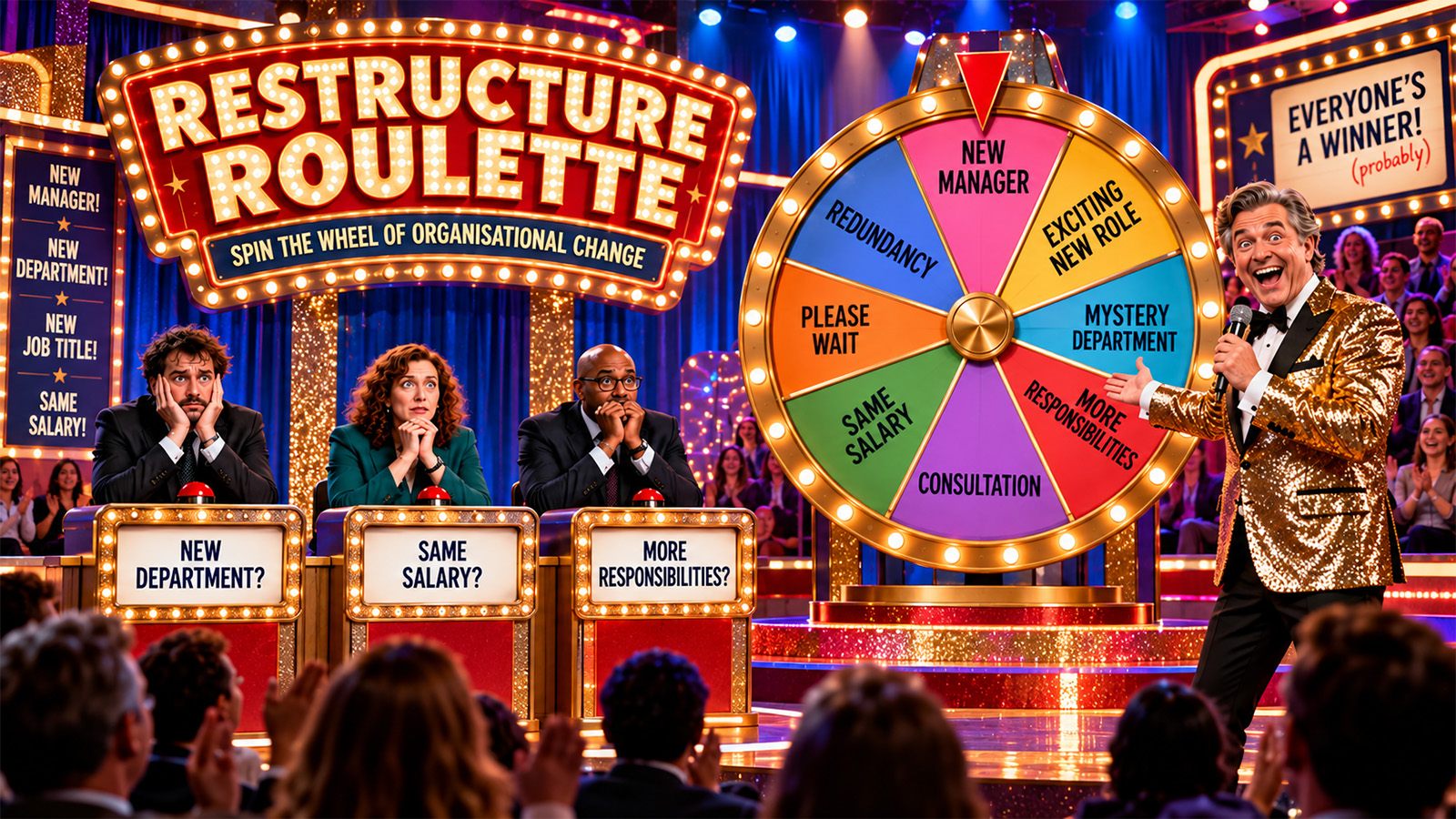
Restructure Roulette: how to communicate a restructure without the gameshow

WELCOME, LADIES AND GENTLEMEN, TO RESTRUCTURE ROULETTE!
The only corporate gameshow where the prizes are mysterious, the rules keep changing and the contestants have absolutely no idea why they've been selected.
I'm your host, Richard Synergy, and boy, do we have an exciting transformation programme for you today!
Behind Door Number One, we have a shiny new operating model!
Behind Door Number Two, a completely different reporting structure!
And behind Door Number Three... REDUNDANCY CONSULTATION!
[Audience falls silent.] Oh. Yes. Perhaps we should have explained that bit more carefully.
But never mind! We've got some fabulous consolation prizes, including an exciting new job title, additional responsibilities and a complimentary stress ball featuring the company logo!
GIVE THAT WHEEL A SPIN!
Of course, organisational restructures aren't really gameshows. For employees facing uncertainty about their jobs, livelihoods and futures, they're anything but entertaining.
But the way some organisations manage and communicate restructures? Well, sometimes it's difficult to distinguish between a carefully planned business transformation and an episode of The Generation Game produced by people who have never met an actual employee.
Mysterious announcements. Confusing terminology. Vanishing departments. Surprise reporting lines. Senior leaders promising an exciting future while everybody else quietly updates their CV. It's quite the spectacle.
And for HR, Change and Internal Communications professionals, there's a serious lesson beneath all the corporate nonsense. Because restructuring an organisation isn't simply about moving boxes around on a chart. It's about changing people's working lives.
So, grab your contestant badge, check your employment contract and prepare to meet your new Head of Strategic Transformation Enablement. It's time to play.
Place your bets: the announcement is only the start
Every great gameshow needs a dramatic opening. And every great corporate restructure apparently needs an email entitled: “An Important Update About Our Future.”
Ah, lovely. Nothing gets the heart racing quite like an unexpected email from the Chief Executive at 4:47pm on a Friday.
The message begins positively. “We've achieved so much together.” That's nice. “We're incredibly proud of our people.” Wonderful.
“But as we look towards the future…”
Oh, bollocks. There it is. The corporate equivalent of hearing ominous music in a horror film.
Within approximately 14 seconds, the office WhatsApp groups have exploded.
- “Have you seen the email?”
- “What does it mean?”
- “Is our department affected?”
- “Why has Karen from HR cancelled her afternoon meetings?”
- “Does anybody know what operational realignment means?”
- “Why has Steve changed his LinkedIn profile to Open to Work?”
And this is where the first mistake often happens. Leadership believes it has communicated the restructure. Employees believe they've been handed the opening clue in a murder mystery. The announcement isn't the communication. It's the beginning of it.
Organisations understandably need to manage sensitive information carefully. There may be legal obligations, consultation requirements and decisions that genuinely haven't been made. But that doesn't mean every announcement needs to sound like it was written by a frightened solicitor trapped inside a corporate thesaurus.
- Tell people what is happening.
- Explain why change is being considered.
- Be clear about what's proposed, what's decided and what's still open.
- Explain who may be affected, what happens next and when people can expect further information.
- And please don't describe a potentially distressing restructure as an “exciting opportunity to accelerate our transformation journey.”
People aren't stupid. They know what a restructure is. They want to understand what it means for them.
In the UK, employers also need to distinguish between informing employees and carrying out genuine consultation. Acas's guidance on redundancy consultation explains the importance of consulting employees about proposed redundancies and considering ways to avoid or reduce them. That's not something you can replace with a beautifully animated PowerPoint.
The gameshow host may know what's behind the curtain. But the contestants deserve a clear explanation of the rules. Preferably before anybody starts spinning.
Spin the wheel: make consultation meaningful
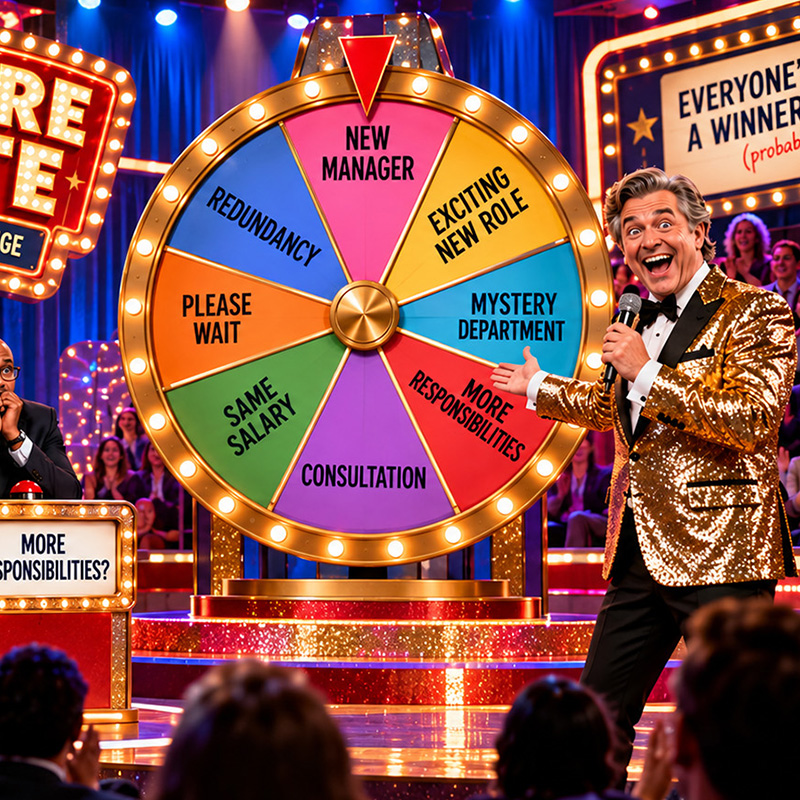
And now, contestants, it's time for our favourite round! THE CONSULTATION SENSATION! The wheel is enormous. The lights are flashing. The audience is nervous.
And the available outcomes include:
- YOUR ROLE IS CHANGING!
- YOUR DEPARTMENT IS MERGING!
- YOU HAVE A NEW MANAGER!
- PLEASE ATTEND ANOTHER MEETING!
- WE CAN'T CONFIRM THAT YET!
- MORE INFORMATION TO FOLLOW!
Round and round it goes. Where it stops, nobody knows. Except, occasionally, everybody suspects senior leadership already knows perfectly well.
And that's where things get dangerous. Because consultation should never feel like an elaborate performance in which employees are invited to contribute after the ending has already been written.
“Thank you for your feedback. We value your input enormously.” Wonderful.
Did anything change? “No.”
Was anything genuinely considered? “We considered it very carefully.”
For how long? “Next question.”
There are legitimate reasons why an organisation might need to restructure. Financial pressures, changing customer needs, technological developments, mergers, duplication of work or strategic priorities can all require difficult decisions.
And consultation doesn't mean every employee gets to veto the proposed changes. But it does mean giving people a genuine opportunity to understand the proposals, raise concerns, suggest alternatives and influence matters that remain open.
For proposed redundancies, employers must follow applicable consultation requirements. Acas's guidance on collective consultation explains the additional legal obligations that apply when an employer proposes 20 or more redundancies at one establishment within 90 days.
For HR and Change professionals, the challenge is making consultation meaningful rather than simply procedural.
- Employees may spot problems nobody considered in the boardroom.
- They may identify duplicated work that could be removed without losing roles.
- They may suggest alternative structures.
- They may highlight operational dependencies that aren't visible on the organisational chart.
- Or they may ask an entirely reasonable question:
“If we're supposed to be creating a flatter structure, why have we appointed another six directors?”
Excellent question, contestant. Unfortunately, that's not one of the approved questions.
The most effective restructuring communication creates room for difficult conversations. It also explains what happens to employee feedback.
- What was considered?
- What changed?
- What couldn't change?
- Why?
Because nothing destroys confidence in a consultation process quite like employees believing the wheel was fixed before the programme began. And if you're asking people to participate in the process, at least have the decency to show them where their contributions went.
Preferably somewhere other than the corporate equivalent of a shredder.
Mystery prizes: explain how the new structure works
CONGRATULATIONS! You've survived the first two rounds. And now it's time to discover what you've won!
Behind the curtain is... A BRAND-NEW JOB TITLE! You used to be Marketing Manager. You're now Senior Customer Experience Transformation and Strategic Engagement Business Partner.
Same desk. Same laptop. Same work. But your email signature now requires planning permission.
Organisational restructures have a remarkable ability to generate new terminology. Departments become functions. Functions become business units. Business units become centres of excellence. Teams become capabilities. Managers become leads. Leads become partners. Partners become heads of things that nobody remembers creating.
And somewhere in the process, the person who used to approve the stationery budget has apparently disappeared into another dimension.
This is where restructures frequently go wrong after the announcement. Leadership unveils a magnificent new organisational chart. It's colourful. It's symmetrical. It's got big, bold arrows. Some of the arrows are even dotted. (There's a key explaining the dotted arrows.)
Everyone applauds.
And then somebody asks: “Who do I report to on Monday?”
Silence. Ah. We hadn't thought of that. The problem is that an organisational chart explains where boxes sit. It doesn't necessarily explain how work gets done.
- Who makes decisions?
- Who owns processes?
- Where do employees go for support?
- Which teams are responsible for what?
- How do departments work together?
- What happens to existing projects?
- And which of the seven newly appointed Directors of Strategic Excellence is responsible for the broken printer?
These are the practical details that determine whether a restructure actually works. For HR and Change teams, the implementation phase needs just as much attention as the initial announcement.
Employees need clear information about their roles, responsibilities, reporting lines and working arrangements. Managers need to understand their new teams. Departments need to agree how they'll work together.
And Internal Comms needs to translate the magnificent new operating model into something that makes sense to somebody who simply wants to get on with their job.
This is where good change communications becomes considerably more useful than another email celebrating the launch of the Future-Fit Operating Framework.
- Explain what has changed.
- Show how it affects everyday work.
- Use practical examples.
- Make information easy to find.
- And keep updating it as the new structure settles.
Because if employees need a detective, a compass and a séance to identify their new line manager, the restructure may not be quite as streamlined as the consultants promised.

Ask the host: answer the questions people actually ask
And now it's time for our interactive audience participation round! The rules are simple. Employees may ask any question they like. Management will then answer a completely different question.
LET'S PLAY!
Employee: “Will there be redundancies in our team?”
Leadership: “We're committed to building a sustainable, future-focused organisation.”
Employee: “Right. But will there be redundancies?”
Leadership: “Our people remain at the heart of everything we do.”
Employee: “Yes, but…”
Leadership: “NEXT QUESTION!”
Thunderous applause from the Executive Leadership Team.
The problem with restructures is that employees tend to ask questions about things that actually matter to them. Their jobs. Their salaries. Their teams. Their managers. Their workloads. Their futures.
Meanwhile, corporate communications can become so heavily sanitised that they stop resembling normal human conversation.
Everything is an opportunity. Every challenge is a journey. Every difficult decision is an exciting evolution of the operating model. And everybody is apparently delighted. Apart from the employees, who are now wondering whether their mortgage provider accepts strategic alignment as a form of payment.
This is where HR, Change and Internal Comms need to work together.
Honesty doesn't mean having every answer. Sometimes the answers genuinely aren't available. Consultation may still be underway. Decisions may not have been made. Individual circumstances may need to be handled confidentially.
That's fine. Say so.
- “We haven't made that decision yet.”
- “We're considering several options.”
- “We can't confirm individual outcomes while consultation is ongoing.”
- “We understand why you're concerned.”
- “We'll update you on Friday, even if there's no final decision.”
These are perfectly respectable things to say.
What isn't particularly helpful is filling the uncertainty with 400 words of corporate blancmange.
And please, don't forget the managers. They're the people who will be cornered in kitchens, contacted on Teams and asked the questions employees don't feel comfortable raising in a town hall. If managers have received exactly the same information as everybody else, five minutes before the announcement, they're going to have a fairly miserable time.
- Give them proper briefings.
- Explain the process.
- Prepare them for difficult conversations.
- Make sure they know what they can and cannot say.
- Give them somewhere to escalate questions.
- And provide support for their own concerns too. Because managers may be affected by the restructure themselves.
Nothing says confident change leadership quite like asking somebody to reassure their team when they're not entirely sure whether they'll still be managing it next month.
The CIPD's April 2026 guidance for people managers emphasises the importance of handling redundancy sensitively and supporting employees through the process. And the Acas guidance on informing employees recommends keeping people informed throughout, not simply announcing the proposals and disappearing.
For the communications team, this means creating a proper rhythm of communication.
- Regular updates.
- Accessible information.
- Clear explanations.
- Manager support.
- Opportunities for questions.
- And, crucially, a consistent account of what's happening.
Not seventeen slightly different versions depending on which senior leader happens to be holding the microphone.
If your restructure requires employees to compare screenshots of leadership emails to work out what's going on, you've accidentally created an escape room. And nobody's enjoying it.
The bonus round: look after the people who stay
CONGRATULATIONS! You've made it through the restructure.
The consultation has finished. The new organisation is in place. The departing employees have left. The organisational chart has been updated. Well, mostly...
And now it's time for our fabulous bonus round!
THE SAME AMOUNT OF WORK WITH FEWER PEOPLE!
Audience groans.
Oh, don't be like that. Remember, we're a leaner, more agile organisation now!
Which apparently means that Janet is doing three people's jobs, Mark has inherited two departments, and somebody has decided this is the perfect moment to launch a new employee wellbeing campaign.
HAVE YOU TRIED MINDFULNESS, JANET?
There's a tendency for organisations to treat the completion of a restructure as the finish line.
The new structure is announced. The project team celebrates. The transformation programme is marked complete. The consultants submit their final invoice. And everyone moves on.
Except the employees. Because for them, the change may only just be beginning.
The people who remain after a restructure can experience a complicated mixture of emotions. Relief that their own role is secure. Sadness about colleagues who have left. Anxiety about what happens next. Concern about workloads. Frustration about lost knowledge. And sometimes a fairly substantial loss of trust.
After all, if the organisation has just gone through one major restructure, what's to stop another?
This is why communication with remaining employees matters just as much as communication during the formal process. And it's why organisations should be extremely careful about launching straight into a celebration of their fabulous new future.
People may have just watched colleagues and friends lose their jobs. Perhaps hold off on the confetti cannons. Instead, acknowledge what's happened. Recognise the contribution of departing colleagues. Explain what support is available. Be realistic about the challenges ahead. Help teams understand their new responsibilities. And give managers time to rebuild relationships and confidence.
There's also a practical issue that often gets overlooked. The work doesn't necessarily disappear when the people do. Organisations need to be clear about which activities will stop, which will change and which will continue.
Otherwise, employees may find themselves carrying the same workload with fewer resources while leadership proudly announces that the restructure has improved efficiency.
If three people previously did a job and now one person does it, that's not automatically an efficiency improvement. It might just be a very tired person.
A good post-restructure communication plan should help employees understand what the organisation now expects, what priorities have changed and what support is available.
And it should create opportunities for people to say when something isn't working.
Not everything can be fixed immediately.
But pretending the new operating model is functioning perfectly while the entire Finance department is quietly sobbing into its spreadsheets probably isn't a sustainable strategy.
Nobody goes home: a restructure is a process, not an event
And now, ladies and gentlemen, we've reached the final round! The lights are dimming. The wheel has stopped. The prizes have been awarded. The host is preparing his closing speech. And the Chief Executive steps forward to announce:
“OUR TRANSFORMATION IS COMPLETE!”
Wonderful!
The new structure is live. The strategy has been refreshed. The operating model is operational. The transformation has transformed. The synergies have been thoroughly synergised. Everybody can go home.
Except...
- Nobody knows who owns the customer complaints process.
- The new department names don't match the systems.
- Two teams think they're responsible for the same project.
- Three others think somebody else is responsible.
- The intranet still shows the old leadership team.
- The new manager hierarchy hasn't been updated in HR.
- And the employee survey suggests that trust has fallen through the floor.
But apart from that? ABSOLUTELY NAILED IT.
This is the fundamental problem with treating organisational restructuring as an event rather than a process.
The announcement isn't the restructure. The consultation isn't the restructure. Even the implementation of the new organisational chart isn't the end of the restructure.
The real test comes afterwards.
- Does the organisation actually work better?
- Are responsibilities clearer?
- Are decisions being made more effectively?
- Do employees understand the strategy?
- Are teams collaborating?
- Do managers feel equipped?
- Are people beginning to rebuild trust?
- And have the changes achieved the business objectives that supposedly justified all the disruption in the first place?
These questions require more than a final project report with lots of green traffic lights. They require ongoing communication, employee feedback and a willingness to admit when something needs adjusting.
This is where change communications should play a central role. Not as the department that makes the announcement look pretty. Not as the team responsible for finding a cheerful stock photo of people high-fiving over a large table. But as a genuine partner in helping employees understand, navigate and adapt to organisational change.
A properly planned internal communications campaign can help create that continuity. It can bring the business rationale to life, support managers, explain new ways of working, provide practical information and keep employees informed as the organisation settles.
And before the programme even begins, a decent Stakeholder Management Plan can help identify who needs to be involved, who will be affected and where communication and engagement need particular attention. Because one of the biggest mistakes organisations make during restructures is assuming everyone experiences the change in the same way.
They don't.
Senior leaders experience the strategy. HR experiences the process. Change teams experience the programme. Internal Comms experiences the announcements, FAQs, briefings and endless requests for “just one small amendment”. Managers experience the difficult conversations. And employees experience the consequences.
Those are very different perspectives on the same restructure. The challenge is bringing them together into something coherent, understandable and, above all, human. Because successful organisational change isn't simply about producing a better-looking structure. It's about helping people work successfully within it.
And that takes more than a spin of the wheel.
Thanks for playing!
Well, what a show! We've had mystery departments, surprise job titles, confusing reporting lines, questionable consultation, disappearing colleagues and enough corporate jargon to render an entire HR department unconscious.
What more could you possibly want?
- A clear strategy?
- Honest communication?
- Meaningful consultation?
- Well-supported managers?
- A realistic implementation plan?
- Employees who actually understand what's happening?
DON'T BE RIDICULOUS. THIS IS A GAMESHOW.
Except, of course, it isn't.
Organisational restructures can be necessary. Sometimes they're essential to an organisation's survival or future success. And the decisions involved can be genuinely difficult. But difficult decisions don't have to be communicated badly.
Employees deserve honesty, clarity, respect and a meaningful opportunity to contribute where consultation is required. Managers deserve proper preparation. HR and Change teams deserve to be involved early enough to influence how the process works.
And Internal Comms deserves a role that extends considerably beyond polishing the CEO's announcement and uploading a new organisational chart.
The CIPD's guidance on managing redundancies makes compassion an explicit part of the process, alongside careful planning, consultation and fair decision-making. Which is a useful reminder that the people affected aren't contestants. They're people.
And while we can laugh at the extraordinary nonsense organisations sometimes create around restructuring, the responsibility to handle change properly is very real.
So, if you're planning a restructure, don't turn it into a corporate gameshow. Explain the rules. Listen to the people affected. Support your managers. Communicate throughout. And remember that the real measure of success isn't whether the new organisational chart looks beautiful.
It's whether the organisation and its people can move forward successfully.
Because nobody should have to gamble their future on a mysterious spin of the corporate wheel.
And on that note, ladies and gentlemen... THAT'S ALL WE HAVE TIME FOR!
Join us next quarter for another exciting episode of Restructure Roulette, when we'll discover whether the brand-new operating model needs restructuring!
Spoiler alert: it does.
GOODNIGHT, EVERYBODY!
About to spin the restructuring wheel? Let's talk
Whether you're planning a restructure, navigating one right now or trying to make sense of what's left afterwards, we can help.
At The Comms Guru, we help organisations communicate change clearly, honestly and effectively, from planning the approach and engaging stakeholders to supporting managers and keeping employees informed throughout.
Because organisational change is difficult enough without turning the communications into a gameshow.
Get in touch and let's talk about how we can help.
No spinning wheels. No mystery prizes. And absolutely no unnecessary synergies.
Sources
Keep reading


Let’s work together

Kick-ass comms. No corporate nonsense.
Guru Mail
Internal comms, minus the blah. In your inbox.
Roughly monthly. A template you can use, a straight opinion and the best thing we have read.
Sign up nowWhat we do
Pick a solution
How we work
Resources


 Certified Members of the Institute of Internal Communication