Gallup's 'State of the Global Workplace' 2026 report

The world of work is wobbling. Your comms can’t afford to.
If you needed a reminder that the workplace is still a gloriously complicated mess of stress, uncertainty, patchy leadership and people quietly muttering “absolutely not” behind muted Teams calls, Gallup’s State of the Global Workplace 2026 report has arrived right on cue.
As ever, it’s a brilliantly thorough and detailed look at the state of the global workforce, offering a wealth of data. We heartily recommend checking it out in full.
The headline? Global employee engagement fell again in 2025, down to 20%, its lowest level since 2020. That is not a tiny blip. That is a full-fat warning light on the dashboard. Gallup says low engagement cost the global economy around $10 trillion in lost productivity, or 9% of global GDP. So yes, this is very much giving “people problem”, not just “process problem”.
And while there is a little good news hiding in the gloom, it comes with a raised eyebrow. Global wellbeing ticked up from 33% to 34% thriving, and job market confidence nudged up to 52%. But stress, anger, sadness and loneliness all remain stubbornly high by pre-pandemic standards. In other words: people may be coping slightly better, but they are hardly skipping into work humming about synergy.
Globally, this is not an AI story. It’s a management story.
One of the most useful takeaways in the report is also one of the most uncomfortable: organisations can keep throwing money at AI, but the real differentiator is still management. Gallup points to a familiar truth with a shinier label: technology only lands when leaders and managers make it make sense for people. Manager engagement has dropped consistently and convincingly from 31% in 2022 to just 22% in 2025 globally, and that slump accounts for most of the wider engagement decline. (Conversely, non-manager engagement has hovered between 18 and 20% over that same period, actually rising one point this year.)
That matters because managers are the translators. They turn strategy into reality, ambiguity into action, and “we’re embracing transformation” into something slightly more useful than a poster and a webinar. In the U.S., Gallup found employees whose manager actively supports AI use are dramatically more likely to see AI as genuinely changing how work gets done. Less than a third of employees in AI-implementing organisations strongly agree their manager is giving that support. Which is another way of saying: the tech might be clever, but the rollout is often a decidedly damp squib.
That is exactly where change comms earns its keep. Because when adoption is patchy, trust is wobbly, and leaders are saying one thing while managers are left to improvise, the answer is not “another email”. It is clearer narratives, better manager toolkits, stronger listening and a comms approach that understands humans are not software updates.
And please don’t think that declining manager engagement is some kind of tragic and unavoidable inevitability. It isn’t. In 2025, Gallup found that 79% of managers in best-practice organisations were engaged at work, almost four times the global average. These standout organisations come from all regions and industries, but they have one thing in common: they do not treat engagement like fluffy HR wallpaper. They make it a long-term strategic priority.
Europe: calmer, but not exactly captivated
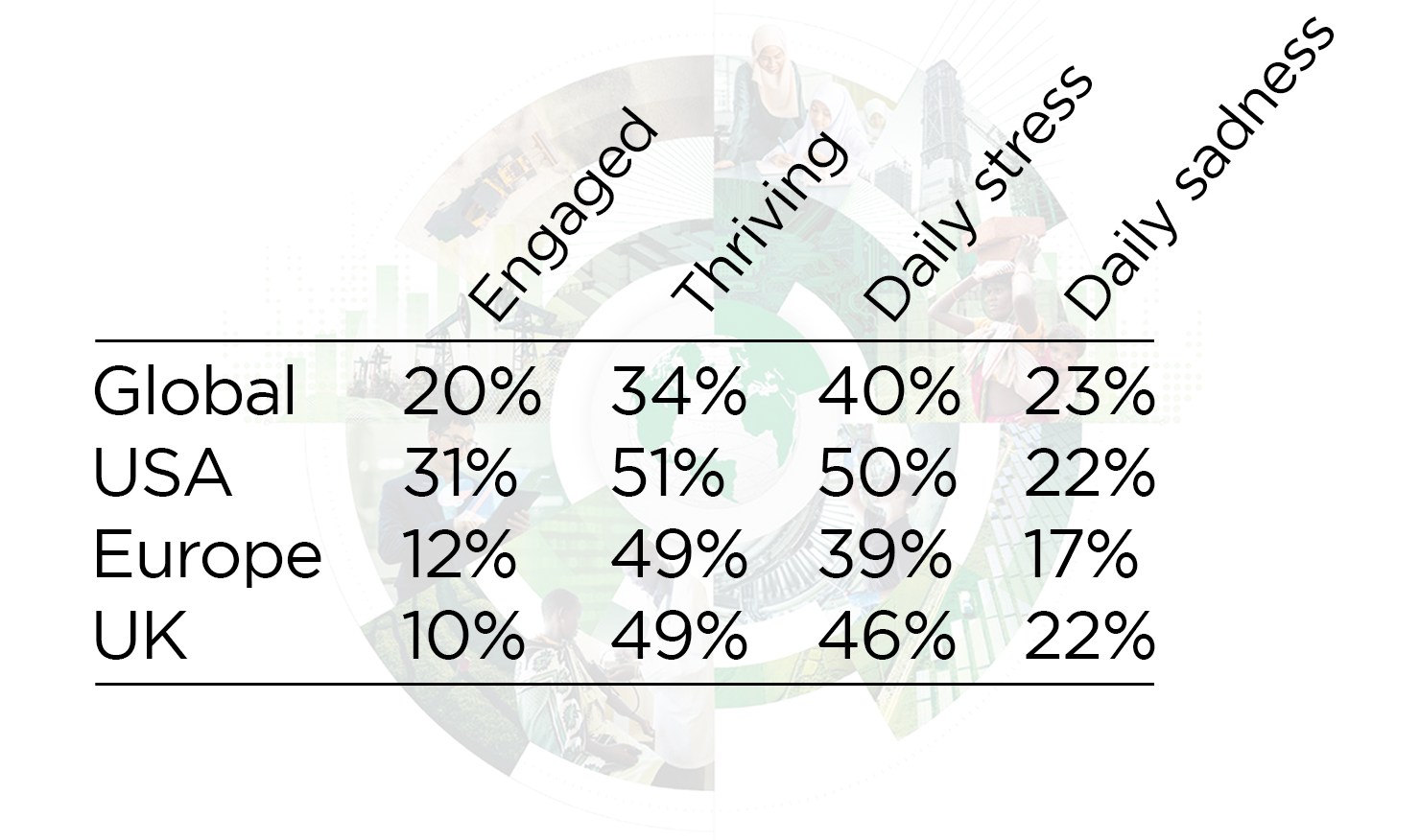
Europe’s numbers are fascinating because they are not all bad. In fact, on wellbeing and emotional strain, Europe looks relatively sturdy. 49% of European employees are thriving, up two points year on year. Daily stress sits at 39%, anger at 15%, sadness at 17% and loneliness at 13%, all below the global averages. Job market confidence is also comparatively healthy at 57%.
And yet Europe still has the lowest engagement in the world at 12%. Twelve. Per. Cent. That is not a flourishing workforce. That is a continent of people broadly holding it together while feeling only loosely enchanted by their jobs. In fact a larger proportion (15%) are actively disengaged. And to directly quote from Gallup’s definition: “Actively disengaged employees are loudly quitting. They aren’t just unhappy at work. They are resentful that their needs are not being met and are acting out their unhappiness. Every day, these workers potentially undermine what their engaged coworkers accomplish.” Ouch!
For communicators, that should set off a very particular alarm. Because low engagement with decent wellbeing often signals a workplace where people are not necessarily in crisis. They are just detached. They are doing the work, attending the town hall, nodding at the strategy, and emotionally investing roughly the same amount that they would in an airline safety demonstration.
That is why a comms health check matters. If your channels are busy but not landing, if your leaders are visible but not connecting, or if your transformation narrative feels technically correct but spiritually dead, you do not need more noise. You need to know where the friction is.
The USA: high engagement, high stress, low confidence
The U.S. and Canada region remains one of the strongest globally for engagement at 31%, well above the global average of 20%. So, on one level, fair play. But scratch the surface and it gets spikier. Thriving has slipped to 51%, daily stress is a punchy 50%, and job market confidence has dropped sharply to 47%, making the region the second-lowest globally on that measure. Since 2019, Gallup says job market optimism in the region has fallen 23 points, from 70% to 47%.
So yes, people may still be more engaged than in many other regions, but they are doing it while stressed, uncertain and increasingly twitchy about the future. That is not exactly a recipe for smooth change adoption. It is more like the organisational equivalent of smiling through a minor electrical fire.
Gallup’s U.S. data also shows concern about AI-related job loss is rising. In early 2026, 18% of U.S. employees said it was likely their job would be eliminated in the next five years due to tech such as automation or AI; in organisations that have implemented AI, that rises to 23%.
Which brings us, once again, back to communication. If your people hear “AI” and mentally translate it as “efficiency drive with a side order of redundancy”, you have a comms problem long before you have a transformation success story. That is where a proper comms strategy comes in: not fluffy messaging, but a plan that aligns leadership intent, employee reality and the language people actually use when they’re being honest.
And the UK? A bit Europe, a bit “you alright?”, a bit quietly knackered
The UK sits inside the wider European pattern, but its own chart is worth a closer look. The report’s UK country page shows 10% engaged, 49% thriving, 49% saying it’s a good time to find a job, 46% reporting daily stress, 15% daily anger, 22% daily sadness and 18% daily loneliness on the 2025 figures shown on page 149 of the report.
That gives us a particularly British cocktail: comparatively decent life evaluation, middling job confidence, and engagement that is, frankly, on the floor. Not “everyone’s burning out spectacularly”. More “everyone’s carrying on, but not exactly bringing the jazz hands”.
This is the danger zone for internal comms teams. Because low engagement does not always look dramatic. It often looks polite. It looks like attendance without attention. Compliance without commitment. Managers forwarding the slide deck and hoping for the best.
So what should organisations actually do with this?
First, stop pretending engagement is an HR side quest. It is a business performance issue, a change readiness issue and, increasingly, an AI adoption issue. Gallup could not be much clearer: the human side of transformation is where the value is won or lost.
Second, get serious about managers. If managers are less engaged, less supported and more overwhelmed, then every strategic message is being handed to the most overloaded link in the chain and asked to survive. Best of luck with that.
Third, audit your comms properly. Not “does the intranet look nice?” (Although, that is important, too!) Properly. Are leaders trusted? Are managers equipped? Are employees hearing the same story at every level? Do people understand what is changing, why it matters and what it means for them?
That is exactly why organisations come to us for a comms health check, sharper comms strategy, hands-on change comms and smarter video production. Because when the workplace mood is this mixed, part weary, part wary, part weirdly hopeful, your communication cannot afford to be vague, generic or allergic to reality.
Final thought
This report is not all doom. Global wellbeing has edged up. Europe is showing some emotional resilience. The U.S. still outperforms on engagement. The UK is not collapsing into the sea of despair. But the overall message is still clear: people do not magically come with change. They do not auto-install belief in strategy. And they definitely do not become engaged because someone wrote “vision” on slides 14, 21, 34 and 47.
If the human side of work is wobbling, then communication is not the finishing touch. It is the stabiliser.
Further reading: Our blog on last year’s Gallup report
Further reading: Why two-way comms is non-negotiable in 2026
Further reading: A guide to using AI well at work
Further reading: Quiet quitting, loud leaving and productivity paranoia
Keep reading
.jpg)
.jpg)
.jpg)
Let’s work together

Kick-ass comms. No corporate nonsense.
Guru Mail
Internal comms, minus the blah. In your inbox.
Roughly monthly. A template you can use, a straight opinion and the best thing we have read.
Sign up nowWhat we do
Pick a solution
How we work
Resources




 Certified Members of the Institute of Internal Communication